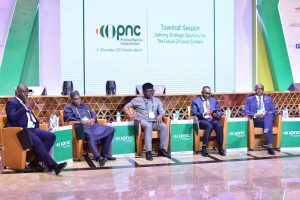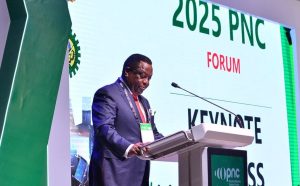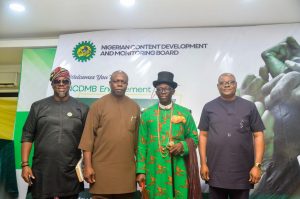
The Nigerian Content Development and Monitoring Board (NCDMB) has held sensitization workshops in Port Harcourt, Rivers State, Abuja and Lagos, for companies and stakeholders operating in the midstream segment of the Nigerian oil and gas industry.
The midstream segment of the oil and gas industry consists of companies and businesses registered engaged in gathering and transmission of oil and gas, pipeline networks, trucking, processing of natural gas to eliminate impurities; liquefaction of natural gas, as in liquefied natural gas (LNG); separation of raw natural gas into dry methane, as well as storage operations, among others.
In his address at the Port Harcourt leg of the event, Executive Secretary of NCDMB, Engr. Felix Omatsola Ogbe said the workshop was convened to deepen stakeholders understanding of compliance requirements under the NOGICD Act; provide clarity on statutory reporting templates, documentation standards and submission timelines; address recurring gaps observed in monitoring and evaluation, and to strengthen collaboration between the Board and all midstream operators.
He urged midstream operators to align their operational strategies with the demands of the Nigerian Oil and Gas Industry Content Development (NOGICD) Act, 2010, to boost in-country value addition and industrial growth.
Speaking to representatives of over 40 companies, the Executive Secretary stated that the midstream subsector “occupies a strategic position within Nigeria’s oil and gas value chain” and that its core business activities, namely, transportation, processing, storage and infrastructural development, are “fundamental to achieving national industrialization objectives.”
Represented by the Acting Director, Monitoring and Evaluation (M&E), Mr. Omomehin Ajimijaye, the NCDMB boss told participants that compliance with the Act is “not only a statutory obligation” but “a strategic imperative for national development.” He pointed out that as a responsive regulator and development agency, the Board considers it an institutional responsibility not only to enforce compliance but also to provide guidance and support where necessary.
He said the Board’s monitoring and evaluation framework is not designed to hinder operations but “to ensure transparency, accountability and measurable progress toward the attainment of 70 per cent Nigerian Content by 2027.” He noted that through effective compliance and accurate reporting, the Board and stakeholders could better measure impact, identify opportunities for local capacity development and unlock better participation of Nigerian companies and professionals in the midstream.
In separate presentations staff of the Project Certification and Authorisation Directorate (PCAD) and Human Capital Development/Capacity Building Directorate, explained key aspects of the Board’s operations.
The Manager, Midstream, Mr. Patrick Opowe June, gave an overview of the workshop, highlighting salient elements of the NOGICD Act, 2010, Ministerial Regulations on Nigerian Content, Implementation of the NOGICD Act, Nigerian Content Statutory Reports, and Consequences of Non-Compliance. The NOGICD Act, he explained, sets two key mandates: to develop capacity of the local supply chain for effective and efficient service delivery without compromising oil and gas industry standards, and to implement and enforce provisions of the NOGICD Act.
In another presentation on Nigerian Content Plan titled “Understanding the Contracting Strategy – Elements of Compliance,” a senior supervisor of the Project Certification and Authorisation Directorate, Engr. Elvis Ogede, drew attention to Section 10(1), which stipulates that a Nigerian Content Plan “shall contain provisions intended to ensure that (a) first consideration shall be given to services provided from within and to goods manufactured in Nigeria.”
He also cited Section 15 of the Act, which states that “All operators and alliance partners shall maintain a bidding process for acquiring goods and services which shall give full and fair opportunity to Nigerian indigenous contractors and companies.”
Engr. Tareowei Bufazi, Deputy Manager, HCD, who stood in for the Director of HCD/Capacity Building Directorate, Engr. Abayomi Bamidele, spoke on “NCDMB Capacity Building Framework,” stating that HCD, as conceived in line with the NOGICD Act, is concerned with how to close identified gaps in terms of relevant skills and operational assets in the oil and gas industry.
He noted that the focus of capacity building has thus been two-pronged – human resources and skill sets, on the one hand, and facilities that provide services within the industry, on the other. He shed further light on what the Board has categorised as project-based training, that is, trainings tied directly to specific oil and gas projects and contracts, and direct intervention training, which refers to programmes for training young graduates and artisans in technical and vocational skills, sponsored by the Board.
In closing remarks, Patrick June expressed heartfelt appreciation to all participants and presenters at the workshop, noting that their participation would help address some of the challenges the companies had faced in the past.
The expectation is for midstream stakeholders and other participants to understand that continuous engagement and communication are essential during the preparation and submission of Nigerian Content Statutory Reports to ensure accuracy and compliance. In addition, companies are encouraged to work with PCAD to assess and maximise their Nigerian Content value addition even before the bidding process.
Obinna Ezeobi, PhD
GM Corporate Communications Division
February 25, 2026
Discover more from Nigerian Content Development & Monitoring Board
Subscribe to get the latest posts sent to your email.