The Nigerian Content Development and Monitoring Board (NCDMB) has unveiled a $100 million Equity Investment Scheme among a raft of fresh initiatives to bolster indigenous capacity and participation in the oil and gas industry.
The Executive Secretary of the NCDMB, Engr. Felix Omatsola Ogbe announced this in a keynote address he delivered at the opening day of the 14th Practical Nigerian Content Forum, which ended on Thursday.
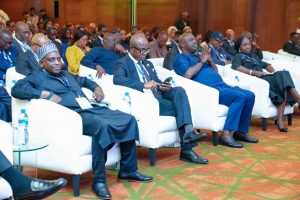
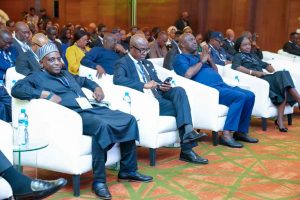
The capacity audience included three ministers of state, members of the Local Content Committees of the National Assembly, a representative of the Bayelsa State Governor, Special Adviser to the President on Energy, two former Executive Secretaries of the NCDMB, Managing Director, Bank of Industry, and captains of the oil and gas industry.
According to Engr. Ogbe, the $100 million Equity Investment Scheme would “provide equity financing to high-growth indigenous energy service companies, while diversifying the income base of the Nigerian Content Development Fund (NCDF).”
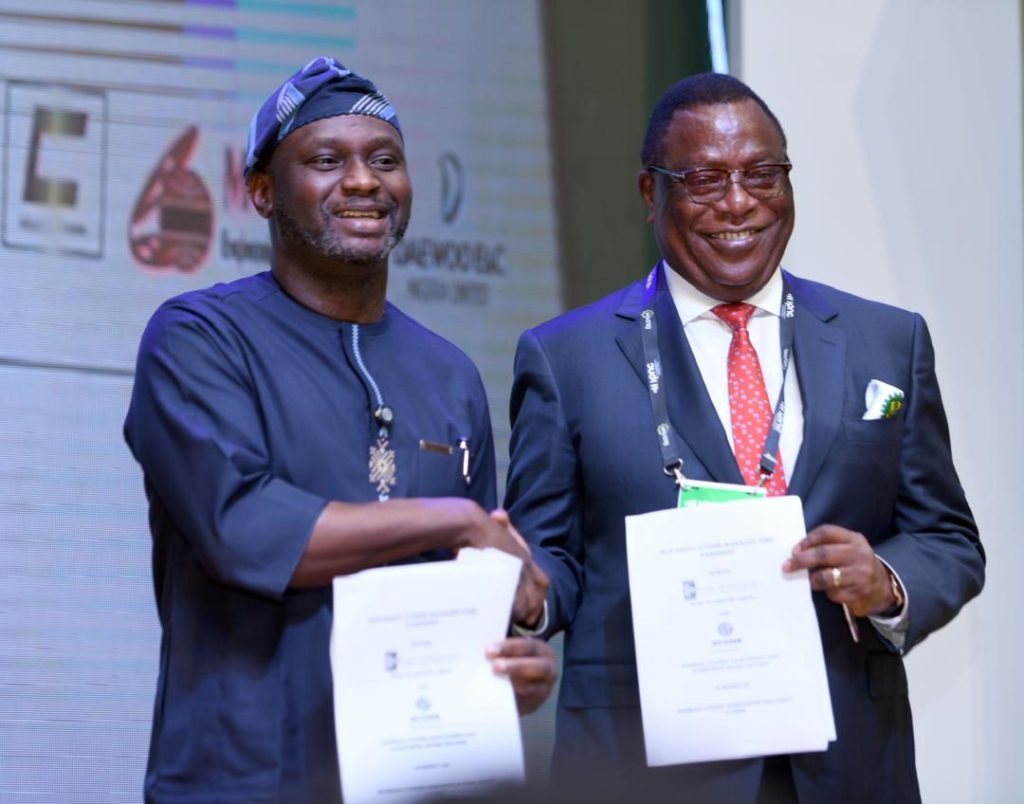
In furtherance of the $100 million Equity Investment Scheme, a memorandum of understanding (MOU) was signed at the event between Engr. Ogbe and the Managing Director of the Bank of Industry, Dr. Olasupo Olusi, toward management of the scheme, which is a new product of the Nigerian Content Intervention Fund (NCI Fund).
The NCDMB boss also announced that 61 per cent Nigerian Content level already attained in the oil and gas sector by the third quarter of 2025 from the projects being monitored by the Board.
Another major announcement was the Board’s readiness to onboard a new set of Project 100 Companies after the successful implementation of approved interventions relating to the first set of Project 100 Companies, launched in 2019, for which an exit plan is slated for April 2026.
Project 100 Companies is an initiative of the Ministry of Petroleum Resources and the NCDMB under which 100 indigenous companies in the oil and gas industry are nurtured and empowered to higher levels of competitiveness through capacity building and access to market opportunities.
He also said the Board has concluded plans to launch its NCDMB Technology Challenge in the first quarter of 2026 and to hold a Research and Development Fair in the second quarter of 2026. In addition, a review of the Board’s seven current guidelines is to be undertaken between the first and second quarter of 2015.
Engr. Ogbe further disclosed that the Board has completed the framework for issuance of NCDF Compliance Certificate, an instrument to confirm that a company in the oil and gas industry has complied with the one per cent remittance obligations. The Certificate will become effective on Ist January 2026 and would be required to obtain key permits and approvals from the Board.
Among recent accomplishments of the Board announced by the NCDMB boss was the expansion of access to community contractors under the Community Contractors Scheme, with over 94 disbursements made in 2025 alone. In addition, the Nigerian Content Academy has commenced operation as a full-fledged division of the Board, with seven of its Lecture Series on key industry issues already organised.
On human capacity development (HCD), the NCDMB has rolled out its Oil and Gas Field Readiness Training Programme for top 10 skills in high demand, on the back of the surge in final investment decisions (FIDs) on big-ticket projects in the oil and gas industry and over 20 Field Development Plans recently approved by the Nigerian Upstream Petroleum Regulatory Commission (NUPRC). The Programme is to ensure availability of indigenous technical capacity at the take-off of the projects.
The construction of the multibillion-naira Oloibiri Museum and Research Centre (OMRC) at Otuabagi in Ogbia Local Government Area of Bayelsa State has also taken off, with the execution of a contract between the construction firm, Julius Berger Plc, and OMRC Limited in December 2024, while mobilisation to site was achieved in July 2025. Jointly sponsored by the Petroleum Technology Development Fund (PTDF), NCDMB, Shell Petroleum Development Company (now Renaissance Africa Energy Limited), and Bayelsa State Government, the project is expected to be delivered within 30 months.
In a presentation, the Chairman, Senate Committee on Local Content, Senator Joel Thomas, expressed concern that some indigenous companies have consistently flouted provisions of the Nigerian Oil and Gas Industry Content Development (NOGICD) Act, 2010, as relates to one per cent remittance to the Nigerian Content Development Fund (NCDF).
His counterpart in the House of Representatives, Hon. Boma Goodhead, commended the NCDMB for sustaining the PNC Forum and Exhibition over the years and for ably guiding industry drive toward attainment of objectives of the NOGICD Act.
In his ministerial address, the Minister of State for Petroleum Resources (Gas), Rt. Hon. Ekperikpe Ekpo, said the theme of the PNC Forum, “Securing Investments, Strengthening Local Content, and Scaling Energy Production,” captures Nigeria’s national priorities that guide interventions by the Board and his Ministry.
He emphasised that “Investment remains the lifeblood of the energy sector,” and that the Board and the Ministry are committed to providing stable policies, transparent processes, and market-driven incentives, to attract long-term capital. He assured that they would “continue strengthening local capacity across fabrication, engineering, technology services, manufacturing of components, and research and development.”
For his part, the Minster of State for Petroleum Resources (Oil), Senator Heineken Lokpobiri, noted with satisfaction that a decade-long stagnation in the oil and gas industry was overcome with the enactment of the long-delayed Petroleum Industry Act (PIA), 2021, and Presidential Directives issued by the Administration of President Bola Ahmed Tinubu in March 2024.
According to him, Nigeria has regained investor-confidence as signalled by the recent surge in FIDs and the increase of oil rigs from 14 to over 60, with 40 currently in active service. “Our investment climate now is globally competitive…our fiscal terms are globally competitive,” he added, while pointing out that “Our policies must be seen to be consistent” at all times.”
He assured that the Federal Government is prepared to support Nigerian Content and the oil and gas industry, but that “things have to be done responsibly.”
The Minister disclosed that “Nigeria has met all its obligations to the African Energy Bank,” and that its Abuja corporate headquarters is fully set with furnishing and all required operational equipment.
Also speaking, the Minister of State for Industry, Senator John Owan Enoh said Nigeria stands at the edge of a profound energy transition “not just a transition from fossil to cleaner fuels, but a transition from import dependence to production strength, from resource extraction to value creation, and from talking about local content to building true local a capacity across value chains.”
In a goodwill message, the Managing Director, BOI, Dr. Olasupo Olusi, said that the collaboration between the NCDMB and BOI marked a significant expansion of a longstanding relationship, while assuring that through the $100 million NCIF Equity Investment Fund, “the Bank of Industry will deploy equity and quasi-equity capital to support high-potential Nigerian companies,” to complement traditional debt financing and “strengthening access to the long-term risk capital required for scale, competitiveness, and value creation.”
According to the BOI boss, “With a single obligor limit of $5 million, the Fund is designed to catalyze multiple high-impact investments while maintaining strong governance and prudent risk management.”
In a goodwill message, the Special Adviser to the President on Energy, Mrs. Olu A. Verheijen, commended the NCDMB for sustaining the PNC Forum, which she said, accelerates change, drives competitiveness, and pushes the industry toward global standards.
She pointed out that as stakeholders chart the path toward building “a resilient, competitive industrial base in Nigeria,” they must be intentional – not incidental – about in-country value addition, and that the historic transfer of onshore assets from international oil companies (IOCs) to indigenous operators “reflects decades of accumulated local capability, technical maturity, and domestic capital formation.”
According to her, “We have living proof of what happens when policy, ambition, and capability align: from SHI-MCI’s fabrication yards to Waltersmith’s modular refining success; from the NLNG Train 7 Project to the Nigerian Oil and Gas Park Scheme, and the expansive growth of Nigerian-owned marine vessels.”
Discover more from Nigerian Content Development & Monitoring Board
Subscribe to get the latest posts sent to your email.