The Nigerian Content Development and Monitoring Board has reinforced Nigeria’s leadership in Africa’s local content development, calling for deeper competitiveness, stronger supply chains and structured continental collaboration as key drivers of sustainable industrialization across the energy sector.
The call was made at the African Content Forum during the 10th edition of the Sub-Saharan Africa International Petroleum Exhibition and Conference (SAIPEC) 2026, where the Board featured prominently across keynote sessions, policy panels and technical engagements focused on translating local content legislation into measurable economic impact.
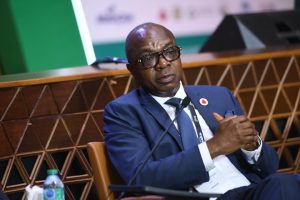
Delivering the keynote on behalf of the Executive Secretary of NCDMB, Engr Felix Omatsola Ogbe, the Acting Director, Project Certification and Authorization Dorectorate, and Special Technical Adviser to the Executive Secretary, Engr Austin Uzoka set the tone for the forum with a clear message: local content cannot thrive without strong, competitive supply chains.
He stressed that local content also depends on economic activity, noting that Final Investment Decisions (FIDs) are the lifeblood of indigenous participation. He noted that local content has its bedrock in supply chains and without a good supply chain, there is no good local content.
“Local content thrives where there is economic development. More FIDs mean more projects, more spend and more local content. If there are no FIDs, 100 per cent of zero is still zero,” Uzoka said.
He challenged stakeholders to commit to driving the local content narrative forward, leveragecapacity across borders and building transparency and trust among African countries to enable sustainable collaboration.
Addressing what he described as “the elephant in the room,” Uzoka warned that goodwill alone cannot attract capital to Africa.
“Capital will go precisely where the opportunities sit and where the economics fit. Africa must be competitive enough to attract capital — not as a goodwill measure,” he said.
The Director highlighted the importance of low-interest financing, policy clarity, streamlined licensing processes and access to credible data, pointing to successful examples such as fast-track licensing regimes and presidential-level sponsorship of local content policies. He also called for deliberate regional cooperation, urging African countries to share facilities, talent and databases.
“If Ghana has capacity, Nigeria can leverage; and if Nigeria has capacity, Ghana can leverage. But this must be built as a long-term relationship, not a one-off transaction,” he noted.
Speaking earlier at the forum, the Founder and Group Chief Executive Officer of Solewant Group, Solomon Ewanehi, reinforced the link between capacity building and national development, describing local content as one of Africa’s strongest industrialisation tools.
“A nation is built when its people can do the work. Capacity is not just training; it is an ecosystem of standards, technology, financing, governance and industrial discipline,” Ewanehi said.
Tracing Solewant’s growth journey, he credited Nigeria’s local content framework and NCDMB’s support for enabling indigenous companies to transition from marginal participation to full-scale manufacturing and service delivery.
“We are proud to be a product of NCDMB. Without Nigerian content, our six factories and specialised facilities would not have happened,” he said.
Ewanehi disclosed that Solewant operates across multiple value-chain segments, recently commissioned an automated pipe and coating plant and has expanded into Namibia. He also highlighted the Solewant Energy Training Institute, developed in collaboration with Nigerian universities, as a practical response to Africa’s skills gap.
Moderating the panel session, the Chief Executive Officer of Radial Circle, Mr Ranti Omole, described local content as a modern economic development tool.
“Local content today is not a slogan; it is a capacity governance tool and a value-addition enabler that grows gross domestic product,” Omole said.
The Chairman of the Petroleum Technology Association of Nigeria and CEO of Geoplex Limited, Engr Wole Ogunsanya, described Nigeria as Africa’s “poster boy” for local content, attributing the success to decades of advocacy and the Nigerian Oil and Gas Industry Content Development Act, 2010.
“That law ring-fenced opportunities for Nigerian companies and changed the trajectory of indigenous participation,” Ogunsanya said, noting that Nigerian service companies now employ thousands and contribute significantly to GDP.
In further discussions, the General Manager, Upstream Monitoring, NCDMB, Engr. Jefferson Tuatongha, outlined procurement reforms driven by presidential directives, including reducing contracting cycles to 180 days and prioritising capable indigenous companies.
“Our categorisation frameworks, joint qualification systems and Nigerian content certification processes are designed to build capacity, ensure quality and reduce costs,” Tuatongha said.
According to him, over 14,000 service providers and 120 operators are onboarded on NCDMB’s digital platforms, with an e-marketplace set to further enhance transparency and efficiency.
On financing, Tuatongha highlighted the $500m Nigerian Content Intervention Fund, offering single-digit interest rates; the $100m Nigerian Content Equity Investment Fund; and a $50m Women in Energy Fund.
“We are putting money where our mouth is — taking equity, supporting gas commercialisation, energy transition projects and regional expansion,” he said.
As discussions closed, NCDMB called for a clear roadmap beyond yearly conferences — one anchored on think tanks, shared databases, infrastructure development and sustained collaboration across Africa.
With strong participation across SAIPEC 2026 sessions, the board’s message was clear: Africa’s energy future will be built not just on resources, but on competitive local capacity, coordinated policy and shared continental ambition.
Discover more from Nigerian Content Development & Monitoring Board
Subscribe to get the latest posts sent to your email.