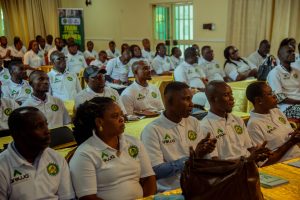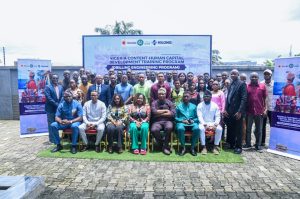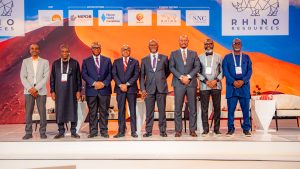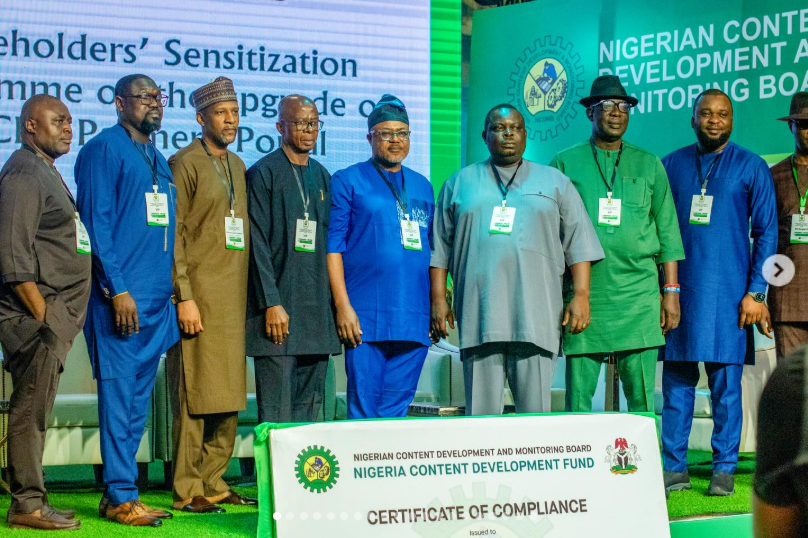
The Nigerian Content Development and Monitoring Board (NCDMB) and development finance giants Bank of Industry (BoI) and Nigerian Export-Import (NEXIM) Bank, on Tuesday in Warri, Delta State, engaged oil and gas industry stakeholders in a well-attended sensitisation workshop to raise awareness on available funding mechanisms and requirements as well as business opportunities in the sector.
Themed “Deepening Local Content through Certificates, Compliance and Financial Support,” the Workshop had as highlight the unveiling of the Nigerian Content Fund Compliance Certificate (NCFCC) Portal. It addressed critical issues, such as the Nigerian Content Development Fund (NCDF) and the Revised Community Contractors Financing Scheme, while providing stakeholders from Delta and Edo States an opportunity for direct interaction with key personnel from the banking organisations.
In an address at the unveiling ceremony, the Manager, Capacity Building Division (CBD) of the Board, Mr. Uchenna Okafor, said the NCFCC aligns with the national vision for ease of doing business, digital transformation, and accountability, just as it reinforces the Executive Orders of the Federal Government released in February 2024.
He described the Certificate as a vital requirement in the oil and gas industry, as contractors and operators, who are required by law to remit one per cent of the value of every upstream contract into the NCDF, have to show it as proof of compliance. The Certificate, he emphasised, is “the key that unlocks access to the [Nigerian Content Intervention] Fund” and serves as “assurance that obligations are being met in line with national development goals.”
The Manager disclosed that “More than $400 million has supported over 130 indigenous companies,” thus addressing the critical challenge of access to finance.” According to him, strategic initiatives like Project 100 Companies have
strengthened local capacity, while innovative financing tools, including a $100 million equity investment scheme by the NCDMB, ensure sustainability.
He pointed out that “as progress expands, our systems must evolve,” noting that in the past, compliance confirmation was handled manually, with companies having to submit physical documents, wait for verification, and endure delays that slowed project approvals, created uncertainty and limited transparency for regulators and investors.
With the launch of the portal, he noted that compliance becomes faster, simpler and more transparent, as the new portal cuts certificate processing time, allows online applications without physical visits or paperwork, and creates a single digital record that investors and lenders can trust.
He summed up the changes by stating that the portal is more than a digital tool, as it signifies “commitment to innovation, accountability, and continuous improvement.”
In his own remarks, the Divisional Head and General Manager, Extractive Industries, Bank of Industry, Mr. Taiye Emaga, expressed appreciation to NCDMB for the continued partnership with his bank in advancing Nigeria’s energy development and industrialisation aspirations.
He said their shared commitment to promoting local content and fostering sustainable growth in the oil and gas sector continues to energise and guide the work and everything the bank does.
According to him, “This partnership represents far more than a series of business transactions; it is a strategic alliance rooted in trust and shared purpose and a collective resolve to deliver tangible and meaningful impact.”
Speaking on the topic “Oil and Gas Financing Opportunities,” the Head, Specialised Business of NEXIM Bank, Mr. Mohammed Awami, expressed satisfaction that his bank has partnered NCDMB to deepen indigenous participation in the oil and gas industry.
He disclosed that NEXIM Bank has handled NCDMB’s $50 million seed fund for indigenous oil and gas companies. The fund, which is in two parts – $30 million for Working Capital and Human Capital Development (HCD) and $20 million for Women in Oil and Gas – has a tenor of up to three years. The $30 million Fund also has a moratorium of up to 12 months and the maximum a company can receive is $1 million (one million dollars).
For a company to qualify for the Working Capital and HCD Fund, its transactions must be connected with the oil and gas industry in the upstream, and such companies must be duly registered with the Corporate Affairs Commission (CAC). It must also be a contributor to the NCDF.
For insights into utilisation of the Fund, he declared, “We have extended our facilities to 74 (seventy-four) indigenous companies,” adding that total disbursements total $55 million. He, however, expressed regret that the Women in Oil and Gas Fund has been underutilized as only $2.5 million has been accessed in the past four years of its existence. He encouraged women to apply, while explaining the procedures.
BoI, represented by Mr. Oladipupo Adebanjo, Senior Manager, Oil and Gas, stated that it manages NCDMB’s $300 million Nigerian Content Intervention Fund (NCIF), which was initiated in 2016 to build local capacity and competencies.
According to him, there are five products under the scheme, namely, asset acquisition, loan refinancing, contract financing, community contractor financing and manufacturing, which is symbolized by the Nigerian Oil and Gas Parks Scheme (NOGaPS).
He pointed out that “pricing is eight per cent interest rate on dollars,” while explaining that “We (BOI) love businesses that are scalable.
In a technical session, a representative of VASCON Solutions, Mrs. Abosede Bozegha, performed a demonstration of NCDF Payment Portal and Compliance Certificate Portal. This was accompanied by a video display to provide a navigation guide on how to pay the 1% per cent NCDF. Also a step-by-step guide on how to apply for certification.
There was a presentation titled “Overview of Compliance and NOGIC JQS Processes,” with NCDMB’s Manager of JQS and E-Market, Mr. Babatunde Akhihiero, as resource person.
He said the NOGIC JQS platform is the sole system for Nigerian Content registration, as stipulated in Section 55 of the Nigerian Oil and Gas Industry Content Development (NOGICD) Act, 2010, and that it is operated in conjunction with industry stakeholders.
He disclosed that the Board uses it to evaluate how Nigerian Content is being applied by the operators and service companies, and that it serves as a database
for national skills development. Nigerians who are seeking job and training opportunities are required to register on the portal.
He also pointed out that there is Nigerian Content Compliance Certification for contractors who have been part of the Board’s tender evaluation processes.
In a panel session, moderated by Mr. Steve Bawa, Chief Executive Officer, SB Capital Limited, resource persons addressed subjects such as Community Contractor Financing Scheme, Community Vendors Participation, and Importance of the Nigerian Oil and Gas Industry Content JQS.
In closing remarks, NCDMB’s Manager, Nigerian Content Development Fund, Mr. Erefagha Turner, thanked the over 300 representatives of companies in attendance for their participation in the workshop. He said the Board is working hard to ensure meaningful participation of indigenous companies and skilled individuals in the oil and gas value chain and encouraged young entrepreneurs to get involved.
Two earlier stakeholder sensitisation workshops were recently held in Lagos and Port Harcourt.
Discover more from Nigerian Content Development & Monitoring Board
Subscribe to get the latest posts sent to your email.